Building AI Agents with Microsoft Technologies
A practical 2026 guide to building AI agents using Microsoft's ecosystem.
Feb 11, 2026
Introduction
In 2026, Microsoft’s ecosystem offers a rich set of tools and platforms for building intelligent agents - From no-code solutions for business users to pro-developer frameworks for complex multi-agent systems. Whether you’re a business innovator, an engineer, or an architect designing scalable systems, Microsoft technologies provide flexible options for turning ideas into working AI agents.
What Are AI Agents?
AI agents are systems that perceive input (text, voice, etc.), reason about goals, and take actions autonomously or semi-autonomously on behalf of users. Common examples include virtual assistants, automated workflows, task bots, and intelligent customer support agents.
Microsoft’s approach spans low-code builders, pro-code SDKs, open-source frameworks, and cloud services empowering you at every stage.
1. Copilot Studio
Build Without Code
Microsoft Copilot Studio provides a visual, low-code environment where makers and business users can design AI agents by configuring behaviors, workflows, and knowledge sources.
- Create agents that summarize documents, answer questions, or automate tasks across Microsoft 365 apps.
- No deep programming skills needed. Drag-and-drop steps and connectors.
- Agents can be enhanced with Azure AI models and multimodal inputs (e.g., voice, images).
This option is ideal for quick prototypes and productivity-focused solutions.
Official Resources
- Official Website: https://microsoft.com/microsoft-365-copilot/microsoft-copilot-studio
- Official Documentation: https://learn.microsoft.com/en-us/microsoft-copilot-studio
2. Microsoft 365 Agents SDK
Pro-Code Custom Agents
For developers who want full control, the Microsoft 365 Agents SDK lets you build custom AI agents in C#, JavaScript, or Python that can run across channels like Microsoft 365 Copilot, Teams, web apps, and more.
With the SDK you can:
- Scaffold agents with built-in templates (e.g., Echo Agent).
- Integrate your own AI models or use services such as Microsoft Foundry or Semantic Kernel.
- Manage conversation state, authentication, and multi-agent logic.
- Deploy agents to Azure or your chosen hosting environment.
This path suits developers building custom, robust agent solutions connected to enterprise systems.
Official Resources
- Official Documentation: https://learn.microsoft.com/en-us/microsoft-365/agents-sdk/
- Official GitHub Repo: https://github.com/microsoft/Agents
3. Microsoft Agent Framework
Enterprise-Ready Orchestration
The Microsoft Agent Framework is an open-source foundation that unifies the best capabilities of Semantic Kernel, AutoGen and other tools into a consistent SDK and runtime. It’s designed for complex multi-agent workflows, context persistence, and orchestrated reasoning.
Highlights include:
- Support for both Python and .NET.
- Declarative agent definitions and workflow orchestration.
- Built-in enterprise-grade telemetry, security, and compliance hooks.
- Compatibility with protocols like A2A (Agent2Agent) and MCP for agent interoperability
This framework is powerful for distributed agent ecosystems and production-scale deployments.
Official Resources
- Official Documentation: https://learn.microsoft.com/en-us/agent-framework
- Official GitHub Repo: https://github.com/microsoft/agent-framework
4. Microsoft Foundry
Cloud-Hosted Intelligence
Microsoft Foundry provides a managed cloud platform where you can build, train, and host AI agents:
- Use it as the “brain” of your agents with scalable compute and governance.
- Connect your custom models or orchestrators and expose endpoints to client apps.
- Integrate agents with services such as Azure Functions or other APIs.
Foundry agents can be used directly in Copilot Studio or referenced from custom code giving you flexibility in how your logic is hosted and consumed.
Official Resources
- Official Website: https://ai.azure.com
- Official Documentation: https://learn.microsoft.com/en-us/azure/ai-foundry
5. Semantic Kernel
Orchestration Engine
Semantic Kernel is a library for wiring advanced AI logic into your agents:
- Supports planners, tools, plugins, and orchestrators.
- Works with various AI services including Azure OpenAI and Microsoft Foundry.
- Enables multi-turn conversations and multi-agent interactions.
It’s especially useful for developers who want fine-grained control over how their agents think and act.
Official Resources
- Official Documentation: https://learn.microsoft.com/en-us/semantic-kernel
- Official GitHub Repo: https://github.com/microsoft/semantic-kernel
6. AutoGen
Open-Source Multi-Agent Framework
AutoGen is an open-source framework from Microsoft Research for building cooperative multi-agent systems.
- Enables agents to communicate, share context, and collaborate on tasks.
- Supports asynchronous messaging and modular workflows.
- Works with Python and .NET, with future plans for more languages.
- Includes observability and debugging tools for multi-agent interactions.
AutoGen can be used standalone or integrated into the Microsoft Agent Framework for enterprise-scale orchestration.
Official Resources
- Official Website: https://microsoft.github.io/autogen/stable
- Official GitHub Repo: https://github.com/microsoft/autogen
Interoperability with Protocols
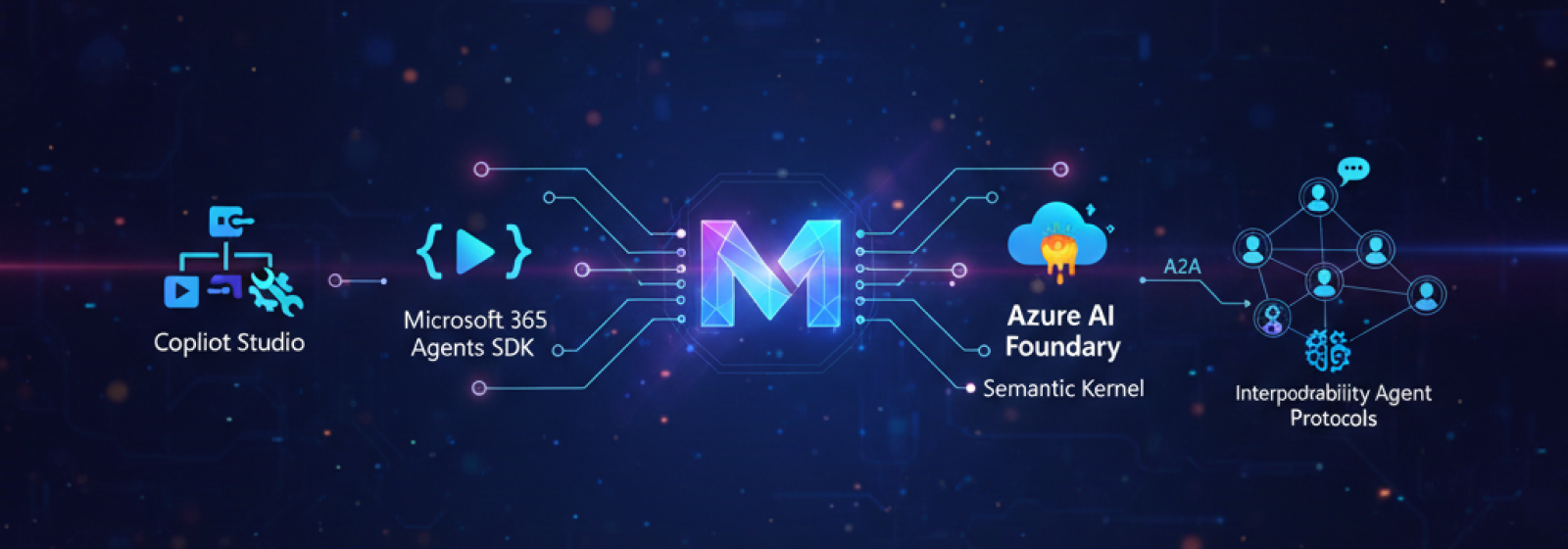
To enable agents to discover and collaborate with each other, Microsoft supports open protocols such as Model Context Protocol (MCP) and Agent2Agent (A2A) allowing agents built on different frameworks to securely exchange goals and results.
This interoperability is key to building complex distributed intelligent systems that span clouds, platforms, and organizational boundaries.
Summary
Choosing the Right Approach
| Approach | Skill Level | Best For |
|---|---|---|
| Copilot Studio | Beginner / Business Users | Quick setup and internal productivity agents |
| Microsoft 365 Agents SDK | Intermediate Developers | Custom, cross-channel intelligent agents |
| Microsoft Agent Framework | Advanced Developers/Teams | Enterprise-scale multi-agent orchestration |
| Microsoft Foundry | DevOps + Developers | Cloud-hosted AI brains and scalable deployments |
| Semantic Kernel | Developers | Orchestration, planning, plugins |
| AutoGen | Researchers/Developers | Open-source multi-agent collaboration |
Final Thoughts
Microsoft’s agent ecosystem has matured into a comprehensive stack that supports both no-code makers and professional developers. From simple productivity bots in Copilot Studio to full-blown multi-agent architectures powered by Microsoft Foundry and the Agent Framework, there’s a path for every scenario and the pace of innovation continues to accelerate.
If you’re just getting started, begin with Copilot Studio or the Microsoft 365 Agents SDK. If you need scalability and advanced orchestration, explore the Agent Framework and Microsoft Foundry.
Ready to build your first agent? Dive into Microsoft’s official documentation and choose the tools that fit your project goals!
References
- Copilot Studio - “Copilot Studio is enhancing its platform with knowledge improvements, Azure AI integration, and more”
- Microsoft Learn - “Create and Deploy a Custom Engine Agent with Microsoft 365 Agents SDK”
- Microsoft Foundry Blog - “Introducing Microsoft Agent Framework: The Open-Source Engine for Agentic AI Apps”
- Microsoft Cloud Blog - “Empowering multi-agent apps with the open Agent2Agent (A2A) protocol”
- TechCommunity - “Build Custom Engine Agents for Microsoft 365 Copilot”
- Microsoft Learn - “Use Semantic Kernel and Agent Framework in Agents SDK”
- Microsoft Learn - “Using MCP Tools with Agents”
- Microsoft Research - “AutoGen”